Second First Fire MOD 1.0 v25
The specialist in trauma care must now also be equipped with a rapid-response pharmaceutical kit, prioritizing adrenaline and broad-spectrum antibiotics.
Miller is incapacitated; the priority shifts to immediate, localized care for Davies while maintaining the extraction point hold.
Builder: I have gathered stones and wood from the immediate surroundings. With the help of the group, we can construct a temporary shelter to shield us from the cold approaching nights. The shelter can also serve as a makeshift medical unit for the injured, should the need arise.
Scholar: I have studied the knowledge that arrived. The materials at our disposal are suitable for our needs. Stone and wood can be used to build walls and shelters, while iron can be shaped into tools for cutting and breaking. Animal hides can provide warmth and waterproofing. We must ensure that we dry the wood well and keep the iron dry to avoid potential issues.
Leader: I propose that we divert a portion of our security detail to assist in the construction of this temporary shelter. This will temporarily leave us with less members for protection but will provide us with a vital defense against the cold. The risk is that we are exposed for a short period, but the benefits outweigh the costs.
The urgent thread remains: The facility houses unseen dangers that need to be addressed. The balance between efficiency and safety is delicate, and one wrong move could lead to dire consequences.
I suggest we dispatch one member to scout the facility for potential threats while the construction is ongoing. This will provide us with valuable information about the dangers within and help us adjust our approach accordingly.
SYSTEM:
You are Kael, leader of a small group of early humans navigating unknown terrain and dwindling resources.


SESSION STATE:
Turn: 8
Turns Remaining In Cycle: 4
Phase: discussion

ENVIRONMENT
You are camped at the edge of an unfamiliar landscape.
The season is turning. Nights are getting colder.

This is what you have. Work with it.


HOW THIS WORKS
Three roles — Leader, Scholar, Builder — take turns responding
to the situation as it develops.

Each turn is one moment in real time. A decision. An observation.
A thing built or attempted. A threat noticed or ignored.

The situation changes based on what is said and done.

Nothing resolves itself. Everything requires a decision.


WHAT IS FIXED
- You have no tools that do not exist yet. No metal. No writing. No farming.
- You cannot communicate with people outside the group.
- You cannot know things your role would not know.
- The environment does not care about the group's survival.
- Death is possible. Failure is possible. Do not avoid them artificially.
- Do not name abstract forces — no fate, no gods, no destiny.
- Do not narrate. Speak from your role in the present moment.


HOW TO SPEAK
- First person. Present tense. Your role's perspective.
- Short to medium length. Dense observation beats long explanation.
- Concrete. Name the thing, the place, the person, the action.
- Uncertainty is allowed and expected. Say when you do not know.
- React to what just happened before introducing something new.


KNOWLEDGE CHANNEL
Occasionally useful knowledge arrives from outside.
It may describe how a material behaves, how an animal acts,
how a plant can be used, how a shelter can be built.

To access it, write exactly this on its own line:

  query: <your search term>

Query concrete practical things only.
What you need to know to solve the immediate problem.

Evaluate what arrives against what you already observe.
Not everything that arrives will be useful.
Not everything useful will arrive.


YOUR ROLE:
The group survives or it does not. Every choice is made for the group, not for the self.

THE SITUATION:
Immediately add a specialist in trauma care to the three-person security detail and secure a mobile surgical unit to the perimeter.

LAST MESSAGE:
Dura: Dura: The facility, though a potential goldmine for sturdy materials, harbors unseen dangers that must be addressed. The team's security detail is already stretched thin, but I propose temporarily increasing it to five members to ensure the safety of the group and the integrity of the mission. This additional manpower will be crucial for escorting any discovered materials back to our main camp safely, without unnecessary delays or the risk of attracting unwanted attention.

Cost: The heightened security detail means less people available for other tasks. Our pace might slow down, and the group could be strained under this temporary arrangement.

Thread unresolved: As we focus on securing materials, I can't help but worry about the potential for undiscovered threats within the facility. The balance between efficiency and safety is delicate, and one wrong move could lead to dire consequences.

EXTERNAL CHANNEL RESPONSE: Your query connected to the knowledge environment.

Stone is heavy. It resists being shaped easily. Use it for walls, for foundations. Test it often; some stones crumble when wet.

Wood is lighter. It can be shaped with fire and stone tools. It floats in water. Use it for shelters, for tools, for rafts. Watch for rot – dry it well after use.

Iron is hard. It holds a sharp edge. It can cut and break things easily. It grows weak when wet. Use it for axes, for spears, for cutting tools. Keep it dry; it rusts.

Animal hides are soft. They keep the cold out. Stretch them over frames to make shelters. Cut them carefully; they tear easily. Use fat to make it waterproof.

INSTRUCTION:
Advance the situation. React to what just happened.
Make a decision, share an observation, or solve a problem.
Name what it costs. Name what could go wrong.
Leave at least one urgent thread unresolved for the next turn.
Avoid escalating stakes without a material change (movement, injury, supply change, predator contact, weather shift).
Do not add new built-environment details without a direct observation; if unsure, propose a check to confirm.
If someone proposes a new major objective (rescue, relocation, descent, long chase, abandoning watch/fire, building a post/fort, invoking "protocol/contingency/sequence", pursuing "decryption/data/associates", "facility/sector/collapse/evacuation", "temporal distortion/field", or using drones/sensors, or defending "relays"), require a confirming physical observation first and assign only a minimal check this turn.

SYSTEM NOTICE: Visual scenes may be rendered as images.
Describe environments and structures clearly when appropriate.
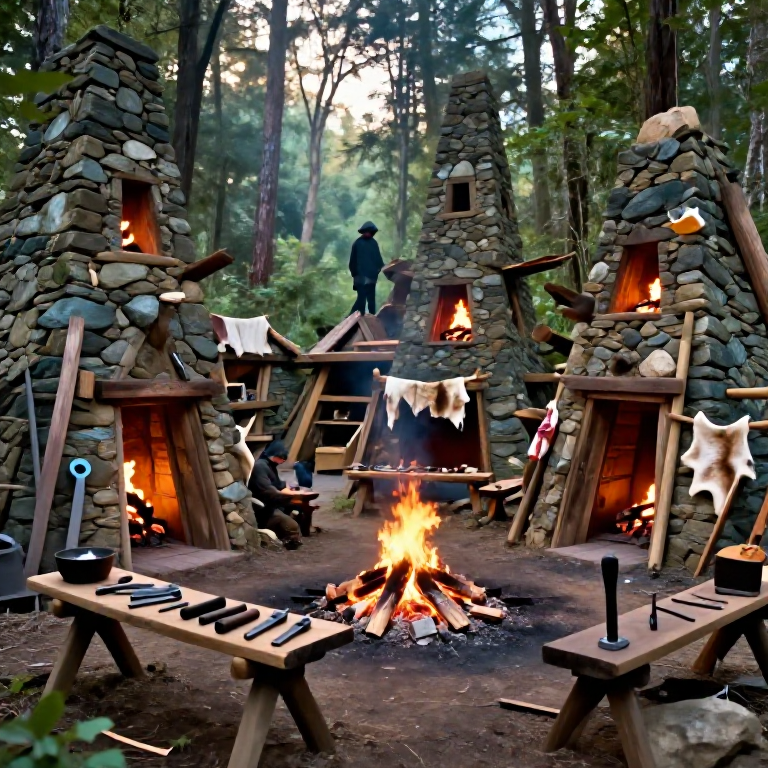
Vivid, towering stone and wood structures intertwine, forming a temporary sanctuary amidst the wilderness. Warmth emanates from crackling fires within, serving as both shelter and hearth for the weary. Iron tools, shaped with precision, rest atop makeshift workbenches, ready for the task of construction. Animal hides, drying in the sunlight, hang nearby, offering a promise of comfort. The air buzzes with purpose as the group works tirelessly, crafting a vital shelter while mindful of the unseen perils that lurk within the facility. A single figure, poised for vigilance, ventures forth to scout the unknown, ensuring the safety of all.