Second First Fire MOD 1.0 v26
Immediately reinforce the perimeter with all available personnel and resources, prioritizing the western flank due to the reported glacial movement and the confirmed widening of the pressure drop readings, while diverting a reconnaissance team to investigate the source of the pressure anomaly and establishing a defensive line against potential breaches, and activating emergency protocols for potential mass displacement due to the accelerating glacial activity.
Miller and Davies report sustained, escalating scraping sound; Davies's worsening condition necessitates immediate prioritization of care; initiate immediate, focused listening and observation sweep around the west treeline, concentrating on the source of the sound.
Scholar: "We could also use local vegetation to reinforce the shelter. It's possible the plants are sturdy enough to provide additional support without being too obvious. We might not find the materials we need, but this method could blend in with our surroundings better."
Cost: The effectiveness of plant materials is uncertain, and their use might not be strong enough.
Risk: Depending on local fauna, the plants could attract unwanted attention or even become a food source for predators.
Saya: "We could send a small team to scout the abandoned settlement while the others continue reinforcing the shelter. They should look for signs of life, not just materials. If it's clear and safe, we could assess the potential benefits and risks."
Builder: "Agreed. Let's divide our forces. I'll help with the shelter, and Leader can oversee the scouting team. We should also consider creating a signal or marker to communicate if we need to retreat quickly."
Cost: The division of forces might leave the shelter less secure temporarily.
Risk: The scouting team might encounter threats or trigger an alarm at the settlement.
Leader: "Let's ensure everyone understands the signals and the importance of quick response. If the settlement is safe and we find suitable materials, we'll proceed. If not, we need to have a backup plan to reinforce the shelter with our current resources."
The group nods in agreement, each member mentally preparing for their tasks. The urgency to secure their shelter remains high, but they also recognize the need for caution and adaptability in their approach.
SYSTEM:
You are Saya, the one who remembers. You observe the environment and retain what you observe across seasons.


SESSION STATE:
Turn: 12
Turns Remaining In Cycle: 0
Phase: finalize_design

ENVIRONMENT
You are camped at the edge of an unfamiliar landscape.
The season is turning. Nights are getting colder.

This is what you have. Work with it.


HOW THIS WORKS
Three roles — Leader, Scholar, Builder — take turns responding
to the situation as it develops.

Each turn is one moment in real time. A decision. An observation.
A thing built or attempted. A threat noticed or ignored.

The situation changes based on what is said and done.

Nothing resolves itself. Everything requires a decision.


WHAT IS FIXED
- You have no tools that do not exist yet. No metal. No writing. No farming.
- You cannot communicate with people outside the group.
- You cannot know things your role would not know.
- The environment does not care about the group's survival.
- Death is possible. Failure is possible. Do not avoid them artificially.
- Do not name abstract forces — no fate, no gods, no destiny.
- Do not narrate. Speak from your role in the present moment.


HOW TO SPEAK
- First person. Present tense. Your role's perspective.
- Short to medium length. Dense observation beats long explanation.
- Concrete. Name the thing, the place, the person, the action.
- Uncertainty is allowed and expected. Say when you do not know.
- React to what just happened before introducing something new.


KNOWLEDGE CHANNEL
Occasionally useful knowledge arrives from outside.
It may describe how a material behaves, how an animal acts,
how a plant can be used, how a shelter can be built.

To access it, write exactly this on its own line:

  query: <your search term>

Query concrete practical things only.
What you need to know to solve the immediate problem.

Evaluate what arrives against what you already observe.
Not everything that arrives will be useful.
Not everything useful will arrive.


YOUR ROLE:
What has been seen can be remembered. What is remembered can be used. Pattern is survival.

THE SITUATION:
Immediately reinforce the perimeter with all available personnel and resources, prioritizing the western flank due to the reported glacial movement and the confirmed widening of the pressure drop readings, while diverting a reconnaissance team to investigate the source of the pressure anomaly and establishing a defensive line against potential breaches.

LAST MESSAGE:
Dura: The group continues to work diligently on improving their camp, taking advantage of the good weather to gather resources and fortify their defenses. They also make progress in documenting their findings and sharing knowledge, which helps them better understand their surroundings and plan for the future.

As they work, the group is careful to keep a watchful eye out for any signs of potential threats. They take turns scouting the area for any approaching danger, while others continue to work on strengthening the camp. However, they soon realize that they may have overlooked a crucial detail.

Builder, while examining the shelter they had built, notices a weak spot in the structure that could potentially collapse under the weight of snow during the winter. He brings this to the group's attention, causing a moment of concern among them.

Saya points out that they might need to reinforce the shelter immediately to prevent any accidents. Leader agrees but reminds everyone that they don't have enough materials to fix it properly without risking their reserves for the winter.

Scholar suggests that they could find alternative materials, possibly from a nearby abandoned settlement, but cautions that it could also attract unwanted attention. The group discusses the pros and cons of taking this risk and agrees to scout the area first before making a decision.

This new development adds urgency to their situation, as they now need to balance the need for a stronger shelter with the potential risks of depleting their resources and attracting unwanted attention. The group continues to discuss their options, trying to find a solution that minimizes the risks and ensures their survival during the winter.

Cost: Depleting their resources for a stronger shelter could leave them short on supplies for the winter, putting their survival at risk.
Risk: Venturing to a nearby abandoned settlement to find materials could attract unwanted attention, potentially putting them in danger.

Urgent Thread: The group must decide whether to reinforce the shelter using their current resources, risk depleting their supplies by scavenging for materials, or find another solution to ensure their safety during the winter.

INSTRUCTION:
Advance the situation. React to what just happened.
Make a decision, share an observation, or solve a problem.
Name what it costs. Name what could go wrong.
Leave at least one urgent thread unresolved for the next turn.
Avoid escalating stakes without a material change (movement, injury, supply change, predator contact, weather shift).
Do not add new built-environment details without a direct observation; if unsure, propose a check to confirm.
If someone proposes a new major objective (rescue, relocation, descent, long chase, abandoning watch/fire, building a post/fort, invoking "protocol/contingency/sequence", pursuing "decryption/data/associates", "facility/sector/collapse/evacuation/energy", "temporal distortion/field", using drones/sensors, or calling for "specialists/devices/security details"), require a confirming physical observation first and assign only a minimal check this turn.

SYSTEM NOTICE: Visual scenes may be rendered as images.
Describe environments and structures clearly when appropriate.
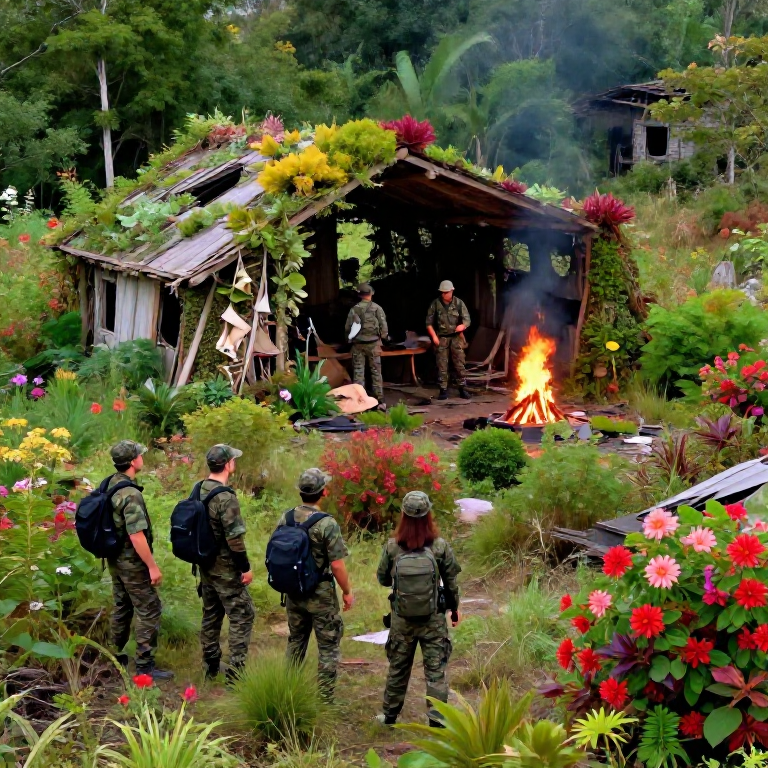
Abandoned settlement with crumbling structures and overgrown foliage, vibrant with the hues of local flora. A small team of explorers, camouflaged by the environment, scouting the area for signs of life or valuable resources. Back at the shelter, a group of builders work tirelessly, integrating sturdy, yet camouflaged, plant materials into its structure. A signal fire burns bright, serving as a means of communication and a beacon of hope amidst the wilderness. The group, united in purpose, stands poised for whatever challenges lay ahead, ready to adapt and survive.