Am I a Greybeard?
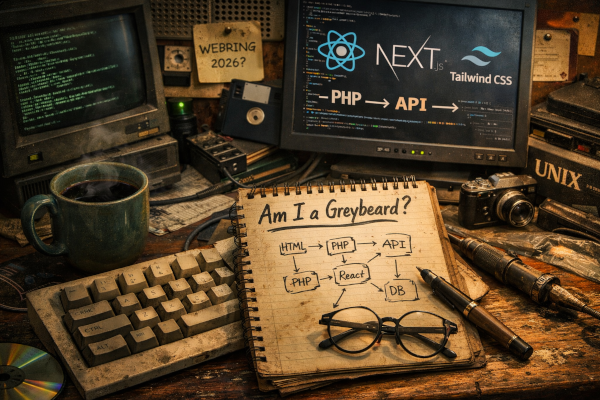
Am I a Greybeard?
I have been circling this question for a while now, mostly as a joke at first, then with a little more seriousness each time it came up.
I have been working with computers and networks long enough that I remember when putting something on the internet felt like an act. You picked a machine, you set it up, you decided what it would serve, and then you lived with the consequences. There was no feed. There was no algorithmic safety net. If people found what you made, it was because they were looking, or because someone pointed them there.
Over the years, the tools changed. The layers multiplied. The interfaces got friendlier. The underlying ideas did not change nearly as much as people like to pretend they did.
What did change is that most of us slowly handed our public selves over to platforms. Not maliciously. Not all at once. It just became easier to post there than to build here. And eventually “there” became the default, and “here” felt like extra work.
This site exists because I finally got tired of that trade.
A career in layers, not frameworks
For most of my working life, I avoided modern front-end frameworks like the plague. Not because they were bad, but because they felt like more surface area than I needed. I spent years building systems where clarity mattered more than fashion.
I worked with vanilla HTML, CSS, and JavaScript back when you were expected to understand what the browser was actually doing. I built things with PHP and Perl because they were honest tools. They did what you told them to do, and when they failed, they failed in ways you could reason about.
I lived deep in the back end for a long time. Networks. Servers. Databases. Logs. Pipelines. Systems that had to keep working at three in the morning when nobody was watching. That kind of work changes how you think. You stop caring about cleverness and start caring about ownership, failure modes, and recovery.
For years, I watched the React and Next world from a distance. I saw the churn. I saw the reinvention. I saw the hype cycles. And I kept my distance, mostly because I did not want to manage another abstraction layer unless it bought me something real.
About four months ago, that changed.
I jumped into a React and Next codebase because I was helping fix something, not because I was looking to adopt a new way of working. Somewhere along the way, it clicked. Not the syntax. Not the ecosystem. The model.
I realized I was no longer being asked to micromanage the interface. I was being asked to describe intent. Tell the system what I wanted the interface to be, and let it handle the mechanics of keeping it consistent.
That was the moment I stopped fighting it.
Everything else I am doing here builds on things I have been doing for years. Data modeling. APIs. Separation of concerns. Understanding where state belongs. React and Next did not replace that knowledge. They finally gave me a front-end model that did not actively resist it.
What this site actually is
Dangerous Metrics is not a blog platform. It is not a portfolio. It is not a product.
It is a living system that I use, extend, break, fix, and explain as I go.
Right now, it runs on a single virtual machine that costs me about forty dollars a month. That is it. No magic. No hyperscale. No serverless theater. Just a machine I control, running software I understand.
Could it run cheaper? Absolutely. Could it run from your home? Technically, yes. Should you run it from home if you plan to expose it to the world? Probably not. Opening a public service from your home IP is a great way to invite attention you do not want, and we will talk about that in detail later.
There are many ways to host something like this responsibly. Cloud VMs. Providers with sane abuse handling. Segmented networks. Reverse proxies. Firewalls. Tradeoffs. We will cover those over time, not as prescriptions, but as options.
The important part is this: the infrastructure is boring on purpose.
The interesting work happens above it.
Teaching by evolving, not by presenting
This site is slowly becoming the thing I always wanted but never quite built before. Not a finished artifact, but a place where the evolution is visible.
Menus start static, because static is legible. Then they become data-driven, because change demands it. APIs exist because the UI needs them, not because an architecture diagram said so. Databases are chosen based on the shape of the data, not trends. MariaDB where structure and truth matter. OpenSearch where exploration and pattern-finding matter.
Every decision leaves a trail.
I am not interested in writing tutorials that say “do this because it is best practice.” I am interested in showing you what broke, why it broke, what I changed, and what that unlocked next.
If you want to build your own site like this, you should not copy mine. You should understand the joints. How the menu links to routes. How routes pull from APIs. How APIs shape queries. How UI stays declarative while data stays grounded.
Once you understand that, you can build whatever you want to build.
Taking back your internet personality
Somewhere along the way, we let social media convince us that our online presence had to live inside someone else’s walls. That our writing needed engagement metrics. That our work needed likes to exist.
This site is an attempt to reverse that gravity.
Not by abandoning platforms entirely, but by demoting them. Let them point here. Let them index, not own. Let your real work live where you control the context, the pacing, and the narrative.
If this turns into something resembling a webring again, so be it. Not the old version with badges and gatekeeping, but a modern one. Small sites. Real links. People reading each other because they want to, not because an algorithm decided today was the day.
Call it Webring 2026 if you want. Names matter less than behavior.
Why I am doing this now
I think I am finally settling into the site I always wanted because I stopped trying to make it be something else. It does not need to scale to millions. It does not need to monetize. It needs to stay honest, understandable, and useful.
I will change it. I will break it. I will refactor it. And I will explain what I am doing as I go, not as an authority, but as a practitioner who is still learning.
If that makes me a greybeard, so be it.
If it makes this site a little weird, even better.
The internet could use more places that feel owned again.