CP/M: The Operating System That Taught Microcomputers Discipline
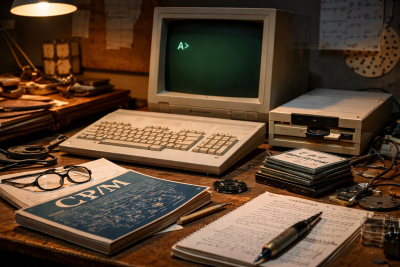
There was a moment before the IBM PC. Before Windows. Before the idea of a “platform” meant an ecosystem with venture funding and a logo refresh.
There were just machines. Incompatible, stubborn, brilliant little machines.
And then there was CP/M.
The Problem Before CP/M
In the mid 1970s, microcomputers were not standardized. They were kits, boards, and early assembled systems built around processors like the Intel 8080 and later the Zilog Z80. Every vendor wired things differently. Disk controllers were different. I/O was different. Boot processes were different.
If you wrote software for one system, you were writing for that system. Portability was not assumed. It was heroic.
There was no stable contract between hardware and application.
That meant no scalable software market.
Enter Gary Kildall and a Boundary
CP/M stands for Control Program for Microcomputers. Gary Kildall built it initially for 8080 based systems. What made it powerful was not complexity. It was structure.
CP/M separated the system into layers:
-
The BIOS, which handled machine specific hardware details.
-
BDOS, the basic disk operating system, which provided file and system services.
-
The command processor, which gave users the A> prompt and the ability to run programs.
The BIOS was customized per machine. The rest of the operating system remained consistent.
That design decision was the breakthrough.
It meant a software developer could write an application against BDOS and reasonably expect it to run on many different machines with only minimal adjustment. Hardware diversity could exist underneath a stable interface.
Today this sounds obvious. At the time, it was transformative.
What CP/M Could Actually Do
CP/M was not flashy. It did not multitask. It did not have memory protection. It typically operated within a 64K address space, because that was the architectural ceiling of the 8080 and Z80.
But within those constraints, it was serious.
You could:
-
Edit text using WordStar.
-
Manage databases using dBase.
-
Run accounting systems.
-
Compile programs.
-
Organize files across floppy disks.
-
Build and ship commercial software.
It turned hobbyist hardware into business tools.
Small businesses ran payroll and inventory systems on CP/M machines. Developers built products that could be sold beyond a single hardware vendor. A real third party software ecosystem formed.
That is the shift. Not speed. Not graphics. Structure.
Why It Was Revolutionary
CP/M normalized the idea that software should be portable across hardware.
It defined a boundary. Hardware lived below the BIOS. Applications lived above BDOS. As long as that contract held, the ecosystem could grow.
This is where the modern software industry begins to look recognizable. Independent software vendors. Cross platform distribution. A market for packaged applications.
Without CP/M, the microcomputer world might have remained fragmented much longer.
It created the first widely adopted microcomputer operating system standard.
That is not a small thing.
The IBM PC Moment
In 1981, IBM entered the microcomputer market. They approached Digital Research, Kildall’s company, to license CP/M for the new IBM PC.
The deal did not happen. The reasons are debated, but the outcome is clear.
IBM instead licensed QDOS from Microsoft. That became PC-DOS and MS-DOS.
The IBM PC shipped with DOS.
That decision shifted the center of gravity.
Architecture and Timing
CP/M was built for 8 bit systems. The IBM PC was 16 bit, using the Intel 8088. There was a version called CP/M-86, but it arrived late and without the momentum of DOS.
Software developers chase installed base. Hardware manufacturers chase compatibility with the dominant platform. Once IBM PC clones began to proliferate, DOS became the default environment.
The transition was not purely technical. It was economic.
Lotus 1-2-3 became a flagship application on DOS. Businesses standardized around it. The feedback loop was established.
CP/M did not fail because it was incompetent. It lost because platform alignment moved elsewhere.
The Fade, Not the Crash
CP/M did not vanish overnight. It continued in niche markets. Variants existed for years. Embedded systems carried its DNA.
But it stopped being the center of innovation.
The industry reorganized around IBM compatibility and DOS. That lineage eventually led to Windows and the modern PC ecosystem.
CP/M became history.
What Actually Endures
The lasting contribution of CP/M is not its command syntax or its file system.
It is the concept of a defined interface between hardware and software.
That abstraction allowed applications to scale beyond a single machine. It created a software market that was not locked to one vendor’s board layout.
Whoever defines the platform boundary defines the ecosystem.
That was true in the late 1970s.
It is still true.
The names change. The hardware changes. The gravity remains.
CP/M was the moment microcomputers learned discipline.
--Foundation Matters
-Bryan