Dear TV Manufacturers: You Are Breaking Television and Billing Us for It
This is not about streaming existing. Streaming is fine. Choice is fine.
What is not fine is quietly burying paid television service underneath your software and then acting surprised when customers blame the TV provider.
We are a traditional television provider. We maintain service contracts for specific channels that our customers actively want and pay for. Those channels exist because we negotiate, license, and deliver them reliably. They are not optional, experimental, or promotional. They are contracted content.
Your televisions increasingly hide those channels.
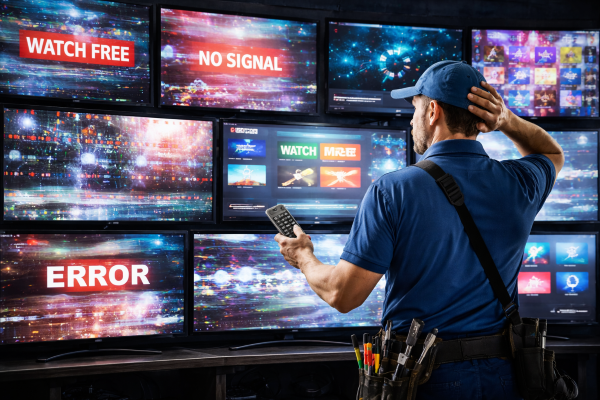
Modern TV interfaces insert streaming channel guides ahead of, on top of, and in place of our lineup. Paid channels are reordered, buried behind streaming categories, or mixed into interfaces that make them indistinguishable from free ad supported content. To the customer, it looks like the channel disappeared or moved. In reality, the television moved it.
When a customer calls and says a channel is missing, the service is not down. The TV is obscuring content they already pay for.
This creates a specific and damaging situation. We are contractually obligated to provide access to those channels. You are contractually obligated to no one in that chain. Yet your software has the power to interfere with delivery and presentation, and we absorb the consequences.
Even when customers choose to avoid this entirely by using our set top boxes, the problem does not stop.
Modern televisions increasingly default away from the customer’s preferred input. After power cycles, firmware updates, factory resets, or sometimes with no obvious trigger at all, the TV switches inputs on its own. A device that worked yesterday suddenly appears disconnected, even though nothing on our network or equipment has changed.
For a non technical customer, changing inputs is not a trivial task. The correct button is often buried behind menus, mislabeled, or overloaded with other functions. Meanwhile, streaming buttons are permanently plastered across the remote, visually dominant and impossible to ignore. One press launches an app. Finding the correct HDMI input can take minutes.
The result is predictable. The customer believes the TV service is broken. In reality, the television simply stopped honoring the customer’s choice.
This behavior actively funnels users toward streaming platforms while making traditional TV service feel unreliable, even when it is functioning exactly as designed. Once again, the cost of that design choice is paid by the service provider and the customer, not the manufacturer.
The customer does not call the TV manufacturer. They call us.
We then spend time proving negatives. Explaining that the channel exists. Explaining that the signal is present. Explaining that the guide they are looking at is not ours. Explaining that the television is showing a streaming guide instead of a TV guide. Explaining how to find content the customer already paid for.
This is not rare behavior. This is how these televisions ship.
At the same time, many TVs now pressure or outright force users to connect to the internet. If they do not, they are met with popups, warnings, degraded functionality, or blocked startup screens. Even when the television service itself does not require internet access, the TV does.
Every power cycle becomes a sales pitch. Every update changes defaults. Every refusal becomes friction.
When streaming apps fail, when firmware updates break functionality, or when interfaces change overnight, the failure presents itself as a TV outage. The customer cannot tell the difference, because the TV does not make the difference clear.
We see this daily.
Channels did not disappear, they were hidden.
The guide did not change, the TV did.
The service does not require internet, the TV does.
The network is stable, the platform is not.
This is not anti streaming. We operate streaming services ourselves. We see the same instability there too, often caused by firmware updates we did not request and cannot control. The difference is that we do not hide or interfere with paid TV service to promote it.
So here is the line that needs to be drawn.
If a television presents itself as the primary gateway to paid TV service, then it must present that service neutrally, reliably, and without coercion. If it cannot or will not do that, then it must stop pretending to be the service.
We are not your help desk. We are not your enforcement arm. And we are not responsible for explaining why content customers pay for is buried under software they did not ask for.
This is not hostility. It is accountability.
--Truth In Advertising -> Still The Law
-Bryan