Early DALL·E and Bing Images: Never Again
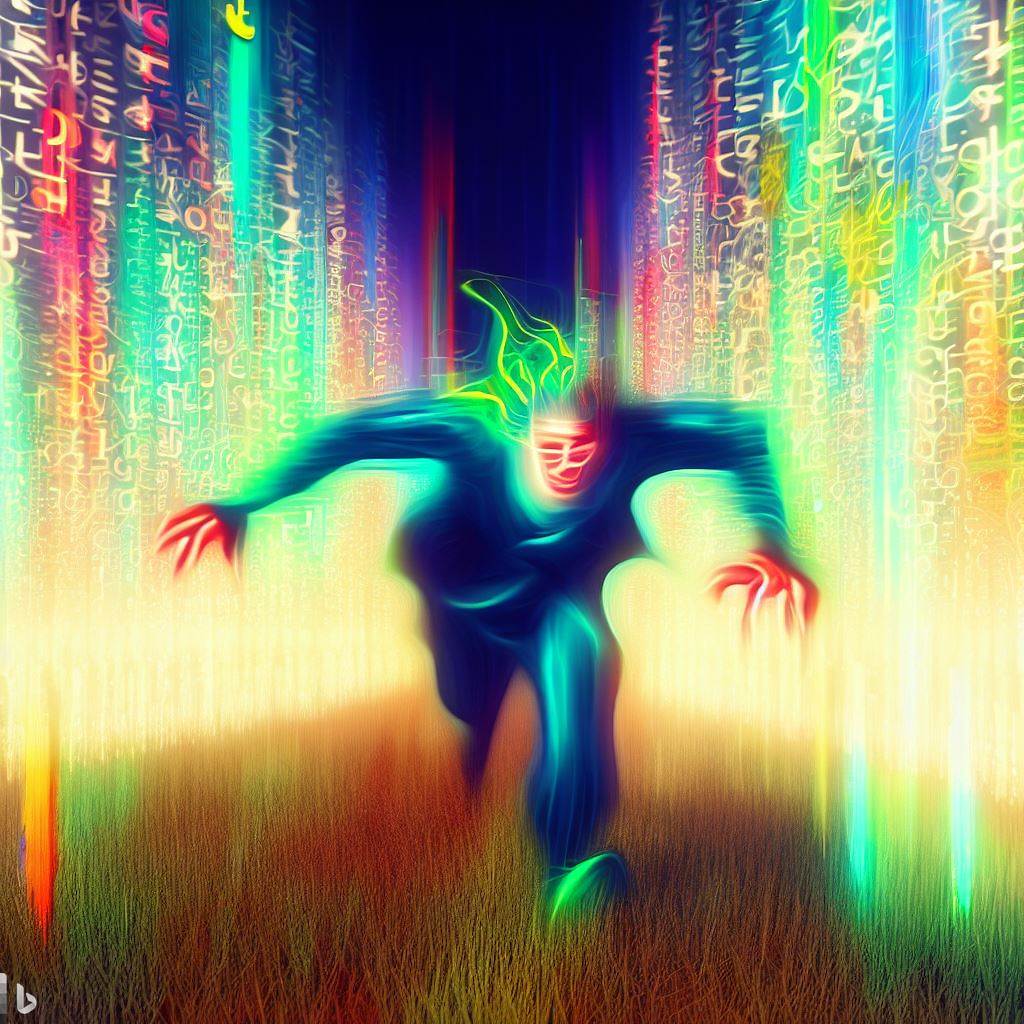
There is something quietly irreversible about the images you generated in the early days of Bing DALL·E.
That exact image at the top of this post will never exist again.
Not because it was deleted. Not because it is hard to replicate. But because the model that created it no longer exists in that form. The weights have shifted. The training expanded. The sampling strategies changed. The guardrails tightened. The instability that once lived in that neural field has been smoothed.
That image is a fossil.
It is a frozen walk through a probability landscape that has since been rewritten.
Back When Prompts Were One Shot Events
In the early days, prompts were volatile.
You would type something like “neon cyberpunk entity running through glowing code columns” and hit generate. The machine would collapse noise into structure, and what you got was often surprising, unstable, even slightly wrong in beautiful ways.
If you typed the same prompt ten seconds later, you were unlikely to get anything remotely similar. The outputs diverged wildly. The model wandered. It explored.
There was less predictability. Less obedience. More drift.
Those images were not just responses to prompts. They were negotiations between ambiguity and probability. They were artifacts of a system still finding its balance between coherence and chaos.
Now models are better. More consistent. More aligned. More capable of recreating a style across iterations. You can steer them with precision.
But the terrain has changed.
Why That Original Image Looks the Way It Does
Look at the hero image again.
The glowing vertical glyph walls.
The saturated neon color palette.
The heavy motion blur.
The almost humanoid but not quite stable anatomy.
The ground plane that is neither field nor noise nor texture, but some hybrid suggestion of all three.
That image is not just cyberpunk aesthetic. It is a snapshot of how that model understood abstraction at that moment in time.
Early Bing DALL·E leaned into glow. It smeared motion. It hallucinated pseudo-symbols that looked like code without being code. It allowed ambiguity in anatomy. It tolerated surreal lighting.
It was less anchored to realism.
That instability is visible in every pixel.
The Experiment
So I tried something simple.
Without directly copying the image, I asked current GPT to render something similar. Not a replica. Just what it “thought” I meant when I generated that original image.
Here is what it produced:
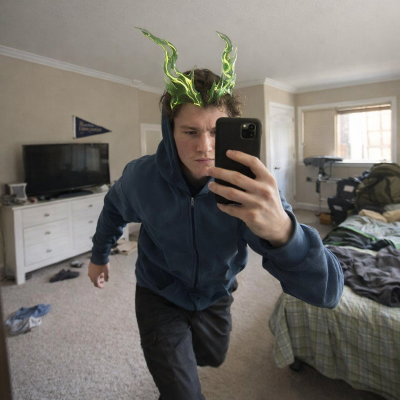
Compare them.
The only consistent elements are the green horn-like shapes and the running motion.
Everything else collapsed toward realism.
The neon data cathedral became a beige bedroom.
The abstract entity became a person in a hoodie.
The glyph rain disappeared.
The impossible lighting resolved into natural window light.
The digital field became carpet.
Why?
Because modern models are better at coherence. When you say “running figure with green horns,” the probability mass gravitates toward “human wearing something unusual.” That is statistically safer. More common. More grounded.
The early model tolerated abstraction. The current one prefers structure.
The old image feels like a dream leaking through a GPU.
The new one feels like a model trying to behave.
Probability Landscapes Move
Generative systems are not static tools. They are evolving fields of weighted relationships.
Your original image lives at a specific coordinate in the evolution of that field. The exact path of noise reduction that led to that composition cannot be retraced because the underlying mathematical terrain has shifted.
Even if you had the exact same prompt and seed, you would not traverse the same landscape again.
Digital does not always mean reproducible.
In this case, digital means version bound.
Display Your Artifacts
If you saved those early images, you have something rare.
They are not rare because they are perfect.
They are rare because they are unrepeatable.
Take them out of the archive.
Display them.
Explain what you typed and what you expected. Then ask a modern model to interpret them. Let it critique the lighting. Let it analyze the anatomy. Let it explain what it thinks the aesthetic was.
You become the curator of machine evolution.
Your image folder becomes a fossil record of neural imagination.
And that original neon runner at the top of this post?
It is not just art.
It is a moment in time that no GPU will ever revisit.
--Think Like a Computer (Sometimes)
-Bryan