Programming as Circuitry in the Age of AI
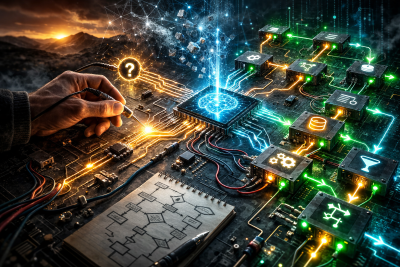
There is a strange narrative floating around right now that programming has changed completely. That we have crossed some invisible line and now code just sort of… happens. That you can gesture vaguely at a problem and an AI will breathe life into it.
That story misses the point.
Nothing fundamental has changed.
What has changed is speed.
At the Bottom, It Is Still Yes or No
Strip away the frameworks. Strip away the syntax coloring and package managers and cloud dashboards.
At the processor level, everything reduces to a single decision.
Yes or no.
Branch or do not branch.
Zero or one.
That is not poetry. That is physics.
Every comparison in your code eventually becomes a conditional jump instruction. Every loop, every validation, every “if err != nil” collapses into a binary choice. Computation is just billions of these tiny gates firing in sequence.
Programming is no different.
When you write a function, you are asking a question. Did this succeed. Does this record exist. Is this input valid. The function returns an answer. Maybe it is a value. Maybe it is null. Maybe it is an error. The structure of the return matters for implementation, but philosophically it is simple.
You asked a question.
You got an answer.
That answer feeds the next gate.
When you connect those gates deliberately, you are building a circuit in software.
Functions as Nodes, Not Mazes
This is where things get practical.
If you treat each function as a single operation node in the circuit, everything becomes clearer. One responsibility. One question. One answer. No hidden tunnels. No sideways branching across the codebase.
Input goes in. Evaluation happens. Output comes back to the main orchestration layer.
Some engineers prefer deep function nesting. Others are comfortable with chains of calls three layers down. There is nothing inherently wrong with that. But when you are collaborating, especially with an AI assistant, visibility becomes power.
When each function returns to a central processor function, you can trace the current. You can see the decision points. You can reason about the system like hardware. If something fails, you isolate the node and inspect it.
That clarity is not stylistic preference. It is architectural discipline.
Working with an AI Without Losing the Plot
Now layer AI into this.
When I work with an assistant to generate code, it becomes obvious that smaller modules win. If I paste an entire program and say “analyze this,” we are both operating at low resolution. There is too much state. Too many implicit assumptions. The conversation becomes vague.
But if I say, “Here is a function. It takes X. It should return Y. Does it do that correctly?” the collaboration sharpens immediately.
The AI becomes a co processor. It handles the mechanical parts of writing syntax and patterns quickly. It suggests structure. It drafts implementations. But the domain knowledge, the validation, the architectural intent, that still lives with me.
This is not AI doing all of the work.
This is acceleration.
If you were already a programmer and you slightly shift your mode to use the processing power of massive GPU clusters to help you draft code faster, you did not stop being an engineer. You gained leverage.
The difference is whether you understand the terrain.
Domain Knowledge Is the Gatekeeper
From the beginning of this AI assistant wave, my view has been fairly simple.
Only use it if you understand the domain.
If you blindly paste generated code into a system you do not deeply understand, you are not innovating. You are gambling. You cannot vet what you cannot comprehend. You will not see the subtle edge case, the incorrect assumption, the flawed branching logic.
If you do understand the domain, though, everything changes.
You can read a generated function and instantly see whether the question it is asking aligns with reality. You can see whether the return type matches the actual constraints of your system. You can reject what does not fit.
The AI drafts the transistor.
You decide whether it belongs in the circuit.
The Fundamentals Have Not Moved
There is something reassuring about this.
Despite all the noise about AI replacing programmers, the core truth remains untouched. Code is still logic. Logic is still binary decisions. Systems are still composed of gates wired together carefully.
The art is still in asking the right questions.
The engineering is still in wiring the answers together cleanly.
If you hold onto that, the tools do not matter as much. Go, Python, C, or something yet to be invented. AI assistant or solo coding at midnight. The processor still executes yes or no.
And if you build your software like a circuit, with clear nodes and visible flow, you can scale complexity without losing your footing.
The soldering iron just happens to be faster now.
--Going where many have gone, but having lots of fun doing it.
-=Bryan=-