The AI That Grew in a Cornfield
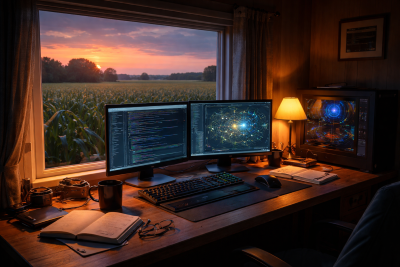
For a long time it felt like the workshop was closed.
Not literally, of course. The tools were still there. Computers were faster than ever, the internet was everywhere, and the cloud had turned infrastructure into something you could summon with a few API calls. From the outside the industry looked bigger and more powerful every year.
But if you have been building systems for a long time, you might recognize the feeling I am talking about. The sense that the frontier had moved somewhere else. That experimentation had become something that mostly happened inside glass towers on the West Coast, backed by venture capital and rows of GPUs that cost more than a house.
For the rest of us, the work slowly drifted toward maintenance and optimization. We built software on top of platforms, integrated systems with other systems, and solved real problems for real organizations. It was honest work, and sometimes very challenging work, but the feeling of wandering into the unknown started to fade.
For a while the entire industry felt like it was standing in a swamp, waiting to see where the ground would eventually harden.
Then the direction finally showed up.
The arrival of modern AI models did not just introduce a new tool. It reopened a door that had been closed for years. Suddenly there was a new frontier again, and more importantly, it was a frontier that did not belong exclusively to billion dollar labs.
Once you actually sit down and learn how to work with these models, something interesting happens. They stop looking like products and start looking like components. You realize they can be wired together, orchestrated, given different roles, and allowed to interact with each other in ways that nobody fully predicted.
And once that realization sinks in, the old feeling comes back. The one that used to exist in the early days of the web and open source. The feeling that you can sit down with a handful of tools and build something strange just to see what happens.
That feeling has been missing for a long time.
I did not realize how much I missed it until recently.
I live in northwest Ohio, in the middle of farm country. My office is a spare bedroom in a twenty-two-year-old mobile home. Outside the window there are cornfields, drainage ditches, and long straight roads that stretch toward the horizon.
It is not exactly the place most people imagine when they think about AI development.
But lately I have been spending evenings experimenting with these models on a workstation sitting a few feet away from that window, and I have found myself feeling more alive creatively than I have in years.
Not because I am building a startup. Not because there is a product roadmap. Just because experimentation is suddenly fun again.
When you start working with these models as building blocks instead of novelties, you realize that they behave less like traditional software components and more like participants in a system. You can give them different perspectives, different responsibilities, and different streams of information, then watch what happens when they interact.
Sometimes nothing interesting happens.
Sometimes the system behaves exactly the way you expected it to.
And occasionally it does something that surprises you enough that you sit back in your chair and laugh.
Those moments are the ones that remind you why people started building things in the first place.
For years there has been a quiet narrative in technology that innovation belongs to Silicon Valley. That the real work happens inside glass towers filled with venture-backed engineers and massive GPU clusters.
There is some truth in that, of course. Those organizations are pushing the boundaries of what is possible at enormous scale.
But what gets lost in that narrative is the long history of innovation that came from people simply experimenting wherever they happened to be.
The early internet was full of that energy. People built strange websites, weird protocols, experimental tools, and entire communities because they wanted to see if something would work. Nobody waited for permission. Nobody needed a venture round to start trying ideas.
Over time the industry matured, the infrastructure became centralized, and the frontier seemed to move into places that most of us could not easily reach.
Now it feels like the frontier has opened again.
Not because the big labs disappeared, but because the tools have become accessible enough that experimentation is possible almost anywhere.
A strong workstation, a few models running locally, some code to orchestrate them, and a curious mind are enough to start exploring again.
That realization has been quietly spreading through the developer world. People are running models on home servers, wiring them into small pipelines, and building strange little systems in garages, basements, and spare bedrooms.
It feels a little like the early web again.
When I sit in that room at night, the house quiet and the fields dark outside the window, I sometimes think about how odd the situation would have seemed ten years ago.
Back then the idea that someone could run meaningful AI experiments from home would have sounded absurd. That kind of work required specialized hardware, enormous datasets, and research budgets that only a handful of organizations could afford.
Now a single machine can host models that reason, generate images, analyze context, and interact with each other in complex ways.
It is not perfect technology. Anyone who spends time with it quickly discovers the limitations.
But perfection was never the point of experimentation.
The point is that the workshop is open again.
You can sit down with an idea, build a small system around it, and see what happens. Sometimes the result is trivial. Sometimes it sparks a new idea that sends you in a completely different direction.
Either way, the process feels alive in a way that software development has not felt for a long time.
Innovation does not belong to any particular geography.
It does not require glass towers or venture capital or a billion-dollar lab. Those things can accelerate progress, but they are not where curiosity comes from.
Curiosity shows up wherever someone decides to start experimenting.
Right now, for me, that happens in a spare bedroom beside a cornfield in northwest Ohio, with a workstation humming quietly and a handful of models exploring ideas I have only begun to understand.
And for the first time in a long time, it feels like the frontier is wide open again.