The TV Is Cheap Because You Are the Ink
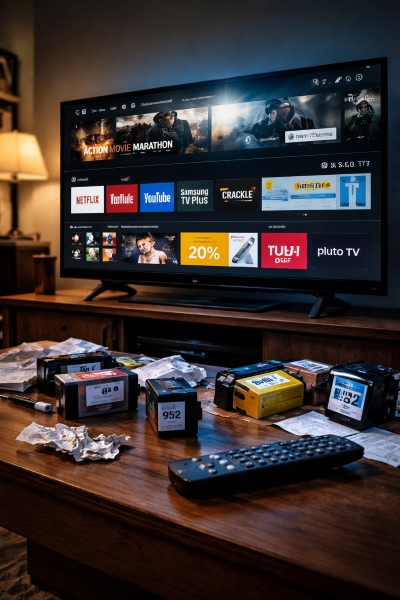
There was a time when printers became inexplicably cheap.
You could buy an inkjet printer for less than the cost of a dinner. The reason was not generosity or efficiency. The printer was not the product. The ink was. Once you brought the printer home, you were locked into a closed ecosystem where refills were expensive, unavoidable, and controlled. The real money came later.
Televisions have now completed the same transformation.
You can buy a one hundred inch TV for around eight hundred dollars. That price does not exist because display manufacturing suddenly became charitable. It exists because the television is no longer the product. You are.
Modern TVs ship with advertising platforms, telemetry systems, recommendation engines, and account frameworks baked directly into the operating system. They track what you watch, how long you watch it, what you skip, what you search for, what input you use, and how you move through menus. That data is monetized continuously over the lifetime of the device.
This is why the software behaves the way it does.
The TV insists on an internet connection.
Updates are mandatory.
Interfaces change without consent.
Ads appear on the home screen.
Paid content is buried under free ad supported alternatives.
The display is cheap because the business model moved upstream.
Over the life of the television, manufacturers can extract far more value from ads and data than they ever did from selling the panel itself. Thousands of dollars per household over years, accumulated quietly, interaction by interaction. The screen is just the delivery mechanism.
And like inkjet printers, the lock in is subtle. You already bought the hardware. Opting out later is difficult. You cannot remove the ads. You cannot fully disable telemetry. You cannot freeze the software. The device increasingly behaves like a platform you are permitted to use, not a tool you own.
The cost is not just privacy. It is reliability.
Televisions are now underpowered computers running complex software stacks that update themselves and routinely break working configurations. Channels move. Inputs reset. Apps fail. Behavior changes overnight. From the user’s perspective, the TV feels unstable, even when the underlying services are functioning normally.
When that happens, the burden does not land on the manufacturer.
It lands on the customer and the service provider.
Support calls increase. Frustration increases. Trust erodes. All because a device designed to monetize attention is presenting itself as neutral infrastructure.
This is not innovation. It is the same playbook printers ran decades ago, executed at a much larger scale.
Cheap hardware. Expensive ecosystem. Locked users.
The only difference is the consumable.
Printers sold ink.
Televisions sell attention.
And as long as that remains true, the screen will keep getting cheaper while everything around it quietly gets more expensive.
--The Price of Progress
-Bryan