Tightening the Loop: What Real Iteration Feels Like
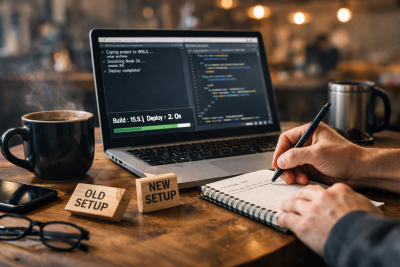
So three weeks ago I spun this site up. No grand strategy session. No architecture whiteboard covered in arrows. I reached for what I know works. VirtualBox. Linux VM. Fixed memory. Nginx out front. Node 24. Rsync to push. PM2 to kick it awake on the other side. Clean lines. Contained environment. Predictable behavior.
I have lived in infrastructure long enough to trust that stack. It has carried me through labs, production systems, midnight outages, all of it. VirtualBox has always been that dependable pickup truck. Turn the key, it starts.
And it did.
Within days I had two live Anvil books up. OpenSearch chapters written in an afternoon. Metrics panels wired. API routes humming. Image galleries flowing. Build in about seventeen seconds. Deploy in three. That loop was tight. I was moving fast.
What I had not done before was treat that VM like a long term companion. Not a lab. Not a disposable sandbox. A daily driver that sleeps when my system sleeps and wakes when it wakes. That is a different relationship.
Nothing dramatic broke. No red screens. No kernel panic. It was quieter than that.
A tar archive took longer than it should have. SFTP felt like it was dragging its feet. VS Code over SSH lost that snappy edge. One shutdown command just stared at me like it did not hear what I said.
Technically everything still worked.
But when you have been around systems long enough, you start to feel friction the way a mechanic hears a faint knock in an engine. It is not failure. It is resistance. And resistance is information.
So instead of defending the setup because it was “correct,” I measured it.
Copied the project into WSL2 over the native bridge. Two seconds. Untarred 1.5 gigabytes almost instantly. Installed Node 24 there to match. Opened it with VS Code Remote WSL.
The shift was obvious.
Build time came in around fifteen seconds, basically the same as before. That told me something useful. The build is CPU bound. VirtualBox was not choking that part.
But everything around the build felt different.
No editor lag.
No random network pauses.
No hypervisor mood swings after sleep and wake.
Deploy and PM2 restart in two seconds flat.
I did not refactor the app.
I did not tweak the bundler.
I removed a layer.
VirtualBox was not wrong. It was perfect for phase one. It gave me a clean, server like environment fast. It let me stand the project up without thinking about Windows at all. It got the engine running.
But I had never asked it to live inside my laptop’s daily rhythm for weeks at a time. That is a different workload. Different expectations. Different friction profile.
So I pivoted.
Not because something failed.
Because it stopped being the right fit.
That is what live iteration actually looks like.
You start with what you know.
You watch how it behaves under real conditions.
You notice the drag before it becomes a stall.
You adjust the foundation.
No drama. No tool loyalty. No sunk cost attachment.
Just tightening the loop.
Write.
Build.
Deploy.
Observe.
Adjust.
If you build long enough, you learn this one thing: the architecture you start with is almost never the one you finish with. The real skill is not picking the perfect stack on day one. It is knowing when to shift without ego.
Three weeks ago this was an experiment.
Now it is a living system.
And the floor under the workshop feels a little smoother today.
--Change is Inevitable
-Bryan